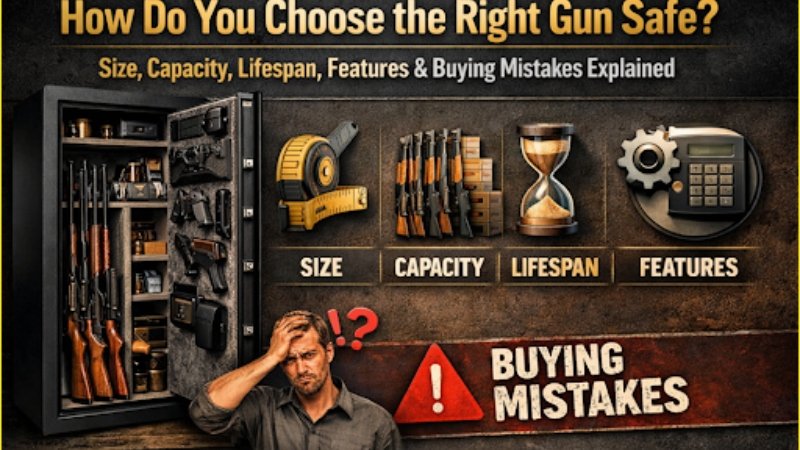
Choosing the right gun safe requires matching your current and future firearm collection to a secure storage solution that meets Australian legal standards. Australian gun laws require that firearms be kept “not easily penetrable” – for example, Category C/D/H guns must be stored in robust steel safes with minimum wall thicknesses (3 mm for long guns, 6 mm for handguns) and fixed installation. Storage of ammunition must be separate (e.g., in a lockable internal box). With these rules in mind, you should assess your types of firearms (long rifles, pistols, etc.) and expansion plan, then choose a safe built of thick steel, quality locks, and sufficient interior space. This guide walks through sizing and capacity, durability (materials and fire protection), key features (locks, shelving, mounting), and common mistakes to avoid, drawing on Australian standards and examples.
Types of Gun Safes: Rifle Safes, Pistol Safes & Cabinets
Gun safes come in several forms. Rifle safes are tall, heavy cabinets designed for long guns (rifles, shotguns). They often hold 5–15 long arms upright on gun racks. For example, Safes Australia lists 10-rifle safes about 1500 mm tall and weighing ~170 kg. These large safes use thick steel (3–6 mm walls, 6+ mm doors) and multiple locking bolts for maximum security. Pistol safes are much smaller – often tabletop or under-shelf models – sized for handguns and small valuables. For instance, the Secuguard SHS3 pistol safe is only 300×400×310 mm and 41 kg, with a removable shelf for ammo or accessories. Gun cabinets (digital or mechanical) are mid-weight solutions; for example a Guardall G3D “5-rifle cabinet” (digital lock) is 1450×350×300 mm and only ~70 kg. Cabinet‐style safes are lighter but must be anchored if under 150 kg. All these safes may be labeled by the firearm categories they approve (e.g. “Cat A B C D &H” for all categories), indicating they meet the construction requirements for those classes. In practice, decide whether you need upright racks for long guns, shelves for pistols, or a mix; rifle safes usually have gun racks and upper ammo bins, pistol safes typically have shelves for ammo/documents.
Size and Capacity: Planning for Today and Tomorrow
Select a safe that fits your current firearms plus some growth. Capacity is often given in “gun slots” (not the exact count of guns you can crammed), so it’s wise to buy a slightly larger safe than you currently need. For example, if you have six rifles now, a “10-gun” safe leaves room for more, plus room to store ammo and other valuables. Interior dimensions matter: most long rifles (30″ or 76 cm barrel) need ~52″ (132 cm) of vertical clearance, so experts recommend ~58″ (147 cm) of interior height to allow room for an upper shelf. Likewise, a safe at least 900–1000 mm wide can comfortably hold 6–10 rifles on one side and shelves on the other. (Tractor Supply notes that a 36″–40″ wide interior lets you fit a rotating 16-gun rack plus shelving.)
Account for other contents too. Pistol safes need shelf space for magazines/ammo. If you store collectibles or documents, consider a fire-rated model (see below). Also check the safe’s depth: long rifle safes should be deep enough (~350–450 mm) to fit rifles without bending or leaning them. Finally, plan for future purchases. Many owners underestimate growth – a common mistake is “always too small”. It’s better to invest in extra space (even if empty for now) than to run out of room later.
Materials, Build Quality, and Lifespan Right Gun Safe
A safe is a long-term investment. High-quality gun safes are built of thick steel and solid construction, which greatly extend their life. Look for steel gauge and build details: industry experts recommend at least 10-gauge (about 3 mm) steel for walls and doors. Eight-gauge (4–5 mm) steel or composite doors are even better. Thicker steel is much harder to cut or pry (a 12-ga or 14-ga sheet is easily breached). Check that all seams and joints are continuously welded (not just spot- or stitch-welded). Many high-end safes use continuous full-length welds and include reinforcement plates around locks.
Built quality also means robust interior fixtures: heavy-duty locking bolts (e.g. 20–30 mm diameter) on multiple sides of the door, and a relamping plate of hardened steel around the lock to prevent drilling attacks. For example, the Secuguard SHS3 pistol safe has 32 mm solid steel locking bolts and a hardened steel lock plate. Verify that the hinges are internal or concealed (harder to cut off) and that the lock mechanism has secondary relockers.
With proper care, a good safe can last decades. Most manufacturers report lifespans of 10–20 years or more with maintenance. Common failure modes are rust or lock wear. To maximize durability: keep the safe dry (moisture causes steel to corrode), use rust inhibitors or dehumidifiers inside, and periodically lubricate the lock and bolt work. Fire resistance is another aspect of durability. Not all gun safes are fireproof, but many have ratings (e.g. 30 min, 60 min at ~1000°F). If you also need to protect documents or high-value items, consider a fire-rated gun safe. Australian retailers list fire ratings (e.g. Guardall G4E has a 30 min fire rating) which indicate how long contents stay below critical temperatures. A fireproof safe uses insulating materials or composite layers to shield contents – these add weight and cost, but significantly improve survivability in a house fire.
Locking Mechanisms and Electronic Security Right Gun Safe
A Right Gun Safe lock is its gatekeeper. Common lock types are key locks, combination (dial) locks, electronic keypad locks, or biometric (fingerprint) locks. Mechanical locks (key or dial) are very reliable and do not depend on power. High-quality key locks (e.g. multi-lever or tubular designs) and dial locks from reputable makers (like S&G, LaGard, ROSS, etc.) are difficult to pick. However, they are slower to open and you must remember/keep the key or combination secure. Electronic locks (with keypad or touchscreen) offer quick access and the ability to change codes easily. Many gun safes (like the SecuGuard and CMI models) offer an UL-listed digital lock as an option. These have programmable master and user codes, lockout on too many tries, and audit trails. You should also have an override key or emergency power option, because batteries can die. For example, the SecuRam digital lock used on many Australian safes is UL-listed and has a secondary relocker plus a backup key. Some electronic locks even support time-delay, dual-control (two-person) modes, and Bluetooth or integration with alarm panels, though these are advanced features you may not need.
Biometric locks (fingerprint readers) add convenience for quick access under stress. Safes Australia notes that modern safes with high-resolution fingerprint sensors “read through common obstructions” and cannot be fooled by smudges. A biometric safe can open instantly for an authorized user without fumbling for a code. However, ensure any biometric lock has a mechanical override in case of sensor or power failure. Security testing has shown some cheap fingerprint safes can be tricked by alternative prints, so choose brands with proven safety (e.g. police- or UL-approved mechanisms). Ultimately, any safe lock should be UL-listed or police-approved if possible. UL-listed locks have been independently tested for resistance to forcing, drilling, etc. In short, pick a high-quality lock and consider dual options (e.g. electronic plus key backup) for reliability.
Modern gun safes often offer electronic or biometric locks for quick access. For example, this Secuguard SHS3 pistol safe (opened above) features a UL-rated SecuRam electronic lock with programmable codes and an override key. When choosing, balance convenience (speed of access) against reliability (battery backup) and security (anti-tamper features).
Additional Features: Shelving, Mounting, Alarms Right Gun Safe
Beyond size and locks, look for these essential features:
- Internal Shelving and Racks. Adjustable or removable shelves let you store ammunition, documents or collectibles neatly. Rifle safes often include a built-in ammo bin or top shelf; pistol safes typically have 1–2 small shelves (for example, the Secuguard SHS3 includes carpeted shelves). Flooring and shelves should be carpet-lined or padded to prevent scratching firearms. A few safes offer rotating racks or horizontal upper shelves for AR-15 uppers, as this is an efficient way to use space.
- Mounting Holes for Anchoring. Almost all large safes come with pre-drilled holes in the base (and sometimes back) for anchoring to floor or wall. Use heavy-duty expanding bolts to fix the safe in place. This is critical: even a very heavy safe (e.g. 200 kg) can be carried off by thieves if not bolted. When buying, confirm the safe has enough bolt holes (four is common) and that anchor bolts are included or specified. In Australia, safes under 150 kg must be bolted to the building structure. Bolting also prevents the safe from tipping when opened.
- Alarm and Connectivity. Some gun safes include audible alarms that trigger on tampering or incorrect code entry. Others can link to home alarm systems. While not absolutely necessary, an alarm-equipped safe adds deterrence: burglars hate time and exposure. If you have a monitored alarm in your home, consider a safe that can tie into it. Another modern feature is internal lighting: a small LED light that activates when the door opens. This is useful when loading or checking the safe’s contents in low light.
- Fire and Water Protection. As noted, some safes are fire-rated. If you store documents or digital media alongside firearms, a safe rated for 60 minutes at 1000°F can be invaluable. Also consider environmental seals: a good safe has door gaskets to keep dust and humidity out. In very damp climates (e.g. Queensland), adding a dehumidifier or silica gel packs inside the safe can prevent rust on guns. (Avoid storing guns in attics/garages where temperatures swing greatly; stable interior climate is best for longevity.)
- Compliance Labels. In Australia, look for safes that explicitly state they meet police or SCEC standards. Some safes are “Government-endorsed” (SCEC) for storing firearms and sensitive documents. Even if you’re a civilian, a safe with a police-vetted lock and construction gives peace of mind. The Safe Central guide notes that approved Category C/D/H safes “must be fitted with concealed hinges and a commercial quality flush mounted lock”, so make sure the model you choose has those features.
Australian Compliance and Legal Requirements Right Gun Safe
Gun owners must follow strict storage laws. In practice, this means buying a safe that meets the regulations for your firearm category and state. Key points (consult local laws for your state):
- Safe Type and Weight. For Category A/B firearms (rimfire rifles, shotguns), the safe must be “not easily penetrable” – steel is preferred. If the safe is under 150 kg, it legally must be anchored to the structure. For Category C/D (semi-autos, restricted rifles) and Category H (handguns), the requirements are stricter: safes must be steel, with minimum thickness (3 mm walls for rifles, 6 mm walls for handguns), and fixed installation. Australian examples reflect this: many 10-rifle safes are built to “Cat A/B/C/D/H” standard on their nameplate.
- Lock Quality. Legislation often requires a “lock of sturdy construction”. This means heavy-duty key or combination locks – cheap padlocks or small cam locks are not acceptable. Look for safes that use police-approved locking mechanisms. Some states even specify 6-lever deadlocks or similar. In any case, avoid brands with known defects (there have been recalls of flimsy big-box safes). Buying a safe with a certified high-security lock (or one endorsed by police) ensures compliance and real protection.
- Anchoring and Security. As above, if the safe (empty) is <150 kg, it must be bolted down. Even for heavier safes, anchoring is strongly recommended. Bolting prevents thieves from dragging off the safe and forces them to attack it on-site. Make sure to install anchor bolts correctly into concrete or structural framing.
- Storage of Ammunition and Parts. The law typically requires ammunition to be stored separately (often in the same safe but in a locked inner box or in a separate small safe). If you have trigger locks or magazines, these must be secured too. Good safes often include a separate ammo box or lockable drawer.
By choosing a safe that explicitly meets the above criteria, you won’t run afoul of regulators or jeopardize your licence. (If in doubt, check with your state’s police firearms unit – but generally, meeting Cat C/D/H specs is safe.)
Common Buying Mistakes and How to Avoid Them Right Gun Safe
Even experienced gun owners can slip up. Here are key mistakes to watch for:
- Buying Too Small. The most frequent error is underestimating space. Only count current guns – forget future purchases, ammo, scopes, or documents. Remember the Tractor Supply advice: “buy a slightly larger safe than what you currently need” to accommodate growth.
- Ignoring Weight and Anchoring. Some buyers assume a heavy safe alone ensures security. But if it isn’t anchored, a determined burglar can winch or drag even a 200 kg safe. As a locksmith guide warns, “you absolutely need to bolt it down”. Always use the bolt holes and supplied hardware.
- Cheap Lock or Construction. A safe is only as good as its weakest part. Don’t be seduced by a “thick door” marketing claim if the interior is hollow or filled with drywall. Some low-end safes have thick doors glued to foam – essentially gift boxes for thieves. Instead, verify the steel thickness (as discussed above) and check that the locking mechanism is robust. Choose known brands or models with UL or police ratings. As one expert advises, “find [a lock] that is UL Listed, the gold standard”.
- Overlooking Legal Compliance. It’s tempting to pick a stylish or inexpensive cabinet, but if it doesn’t meet Category C/D/H specs (thickness, weight, locking bolts), you may not be allowed to use it for restricted guns. Always double-check the safe is approved for your firearm category. Some owners forget that ammunition also needs secure storage.
- Neglecting Fire Resistance (if needed). If you have irreplaceable documents or sentimental items in the safe, failing to get a fire-resistant model is an oversight. Ensure any fire rating claimed is backed by a certification (many retailers list the exact rating, as Safes Australia does for its models).
- Giving In to Gimmicks. Finally, don’t prioritize LED lights, fingerprint scanners, or flashy displays over solid security. As one locksmith puts it, fancy bells and whistles shouldn’t replace “the thickest steel you can afford”. Features like alarms or internal lights are nice, but only after lock quality and steel thickness are ensured.
By anticipating these pitfalls, you can avoid a regretful purchase. Instead, focus on a safe that is robust, appropriately sized, and compliant.
Conclusion
Selecting the right gun safe is a balance of size, security, and compliance. Always start by taking inventory of your firearms and anticipating growth. Choose a safe with enough height and width for your rifles, plus shelves for pistols and ammo. Verify the construction: thick steel walls, solid door, multiple locking bolts, and quality locks (UL-listed or police-approved). Include important features like carpeted shelves, pre-drilled anchor holes, and perhaps an internal alarm. Double-check that the safe meets Australian legal requirements for your firearm category, weight, and mounting. Lastly, learn from common mistakes: don’t skimp on size or quality, and always bolt it down.
A well-chosen gun safe not only protects your firearms and loved ones today, but lasts for decades. Investing in a high-quality safe is an investment in safety, security, and peace of mind. Visit NOTEDPEOPLE.COM For More Details